MealSelf


How Many Calories Should You Eat to Lose or Gain Weight?
Work out your maintenance calories, then eat 300 to 500 a day below them to lose weight or above them to gain. Here is how, with two worked examples.
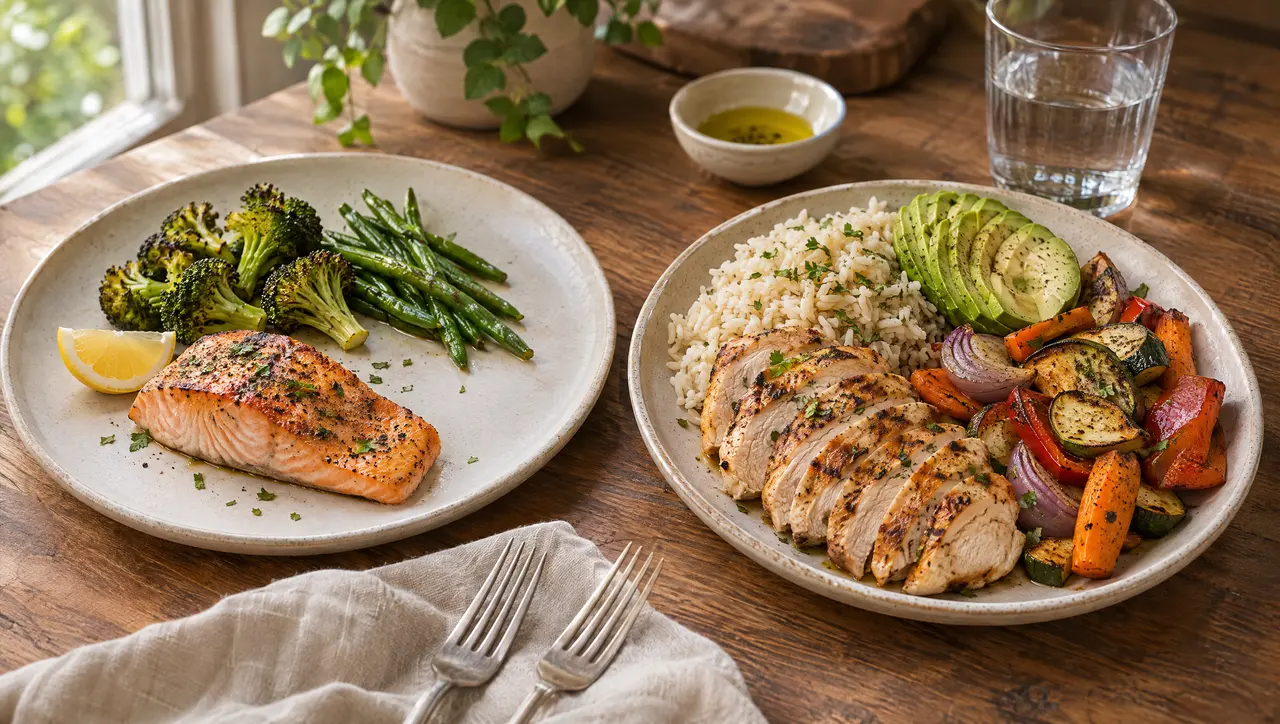
To lose or gain weight, first work out your maintenance calories, the number of calories you burn on a typical day, then eat a little less or a little more than that. For most adults, eating about 300 to 500 calories a day below maintenance is a sensible starting point for weight loss, and about 300 to 500 calories a day above maintenance is a sensible starting point for weight gain. A 500 calorie daily deficit works out to roughly 1 pound (0.45 kg) a week at first, which sits inside the 1 to 2 pounds a week that the CDC describes as a healthy pace. Every number here is an estimate, so treat it as a starting point and adjust based on what your weight actually does over a few weeks.
What are maintenance calories?
Maintenance calories, often called your total daily energy expenditure (TDEE), are the calories your body uses in a day. They are made up of three parts:
- Your basal metabolic rate (BMR), the energy your body needs at rest to breathe, circulate blood and keep warm
- The energy you burn moving, from walking and chores to workouts
- The energy used to digest the food you eat
If you eat close to your maintenance calories, your weight stays roughly steady. Eat consistently below it and your weight trends down. Eat consistently above it and your weight trends up. That is the whole idea behind a calorie deficit and a calorie surplus.
How do you calculate your maintenance calories?
You can estimate maintenance calories in two steps. First estimate your resting calories with an equation, then multiply by your activity level.
Step 1. Estimate your resting calories (BMR)
The Mifflin-St Jeor equation is one of the most widely used formulas for resting calories. It was published in 1990 in the American Journal of Clinical Nutrition, and a 2005 systematic review found it was the most reliable of the common equations, predicting resting metabolic rate within 10% of measured values in more people than the alternatives. Use your weight in kilograms, height in centimetres and age in years:
- Men: (10 × weight) + (6.25 × height) - (5 × age) + 5
- Women: (10 × weight) + (6.25 × height) - (5 × age) - 161
To convert, divide pounds by 2.205 to get kilograms, and multiply inches by 2.54 to get centimetres.
Step 2. Multiply by your activity level
Multiply your BMR by the factor that best matches a normal week:
- Sedentary (desk job, little or no exercise): 1.2
- Lightly active (light exercise 1 to 3 days a week): 1.375
- Moderately active (moderate exercise 3 to 5 days a week): 1.55
- Very active (hard exercise 6 to 7 days a week): 1.725
- Athlete (hard daily training or a physical job plus training): 1.9
The result is your estimated maintenance calories. Most people overestimate how active they are, so if you are torn between two levels, pick the lower one. You can always adjust later.

How many calories should you eat to lose weight?
Subtract 300 to 500 calories a day from your maintenance calories.
- A 500 calorie deficit is roughly 1 pound (0.45 kg) a week at the start. It is a steady pace that most people can notice on the scale within a few weeks.
- A 300 calorie deficit is closer to 0.6 pounds (0.25 kg) a week. It is slower, but the smaller cut is usually easier to live with.
Bigger is not always better. According to the CDC, people who lose weight gradually and steadily are more likely to keep it off. Very low intakes also make it harder to get enough protein, fibre, vitamins and minerals. As a guardrail, MealSelf never plans below 1,200 calories a day for women or 1,500 for men, and anyone who wants to go lower should do it with a healthcare professional.
It also helps to know why weight loss slows down over time. A 2011 study in The Lancet showed that the old rule of 3,500 calories per pound overstates long-term weight loss, because a smaller body burns fewer calories and the body adapts. In practice, the same deficit that worked in month one will do less in month four. Recalculate your maintenance calories after every 5 kg (about 10 pounds) of change. If you want a model that accounts for this adaptation, the NIH offers a free Body Weight Planner.
How much protein should you eat while losing weight?
Protein helps you hold on to muscle while you eat less, and it tends to keep you fuller. The International Society of Sports Nutrition recommends 1.4 to 2.0 grams of protein per kilogram of body weight a day for most people who exercise, which is about 0.6 to 0.9 grams per pound. Pair that with strength training two or three times a week so that more of the weight you lose comes from fat rather than muscle. For targets by age and goal, plus a list of protein in common foods, see how much protein you need a day.
How many calories should you eat to gain weight?
Add 300 to 500 calories a day to your maintenance calories.
- A 300 calorie surplus is a slower, leaner gain. It suits most people who want to add muscle without adding much fat.
- A 500 calorie surplus adds weight faster, but a larger share of that gain is likely to be fat.
Gaining weight in a healthy way is mostly about eating more of the right foods consistently and giving your body a reason to build muscle. Lift weights or do other strength training, aim for the same protein range as above, and spread your food across three meals and one or two snacks.
If you find it hard to eat enough, these habits can help:
- Add calorie-dense whole foods such as nuts, nut butters, olive oil, avocado, cheese, oats, rice and whole milk
- Drink some of your calories with a smoothie made from milk, fruit, oats and peanut butter
- Eat on a schedule instead of waiting until you feel hungry
- Add one extra snack before trying to make every meal bigger
For more ideas, see our guide on how to gain weight with a small appetite.
If you are underweight without knowing why, or you are losing weight without trying, see a doctor before you start a weight gain plan.
What does this look like in real numbers?
Here are two worked examples using the steps above. Your own numbers will differ.
Example 1. Losing weight
A 35-year-old woman who is 165 cm (5 ft 5 in) tall, weighs 75 kg (165 lb) and is lightly active.
- BMR: (10 × 75) + (6.25 × 165) - (5 × 35) - 161 = about 1,445 calories
- Maintenance: 1,445 × 1.375 = about 1,990 calories
- Weight loss target: 1,990 - 500 = about 1,490 calories a day, or about 1,690 for a gentler 300 calorie deficit
- Protein if she strength trains: about 105 to 150 grams a day
Example 2. Gaining weight
A 25-year-old man who is 178 cm (5 ft 10 in) tall, weighs 65 kg (143 lb) and is moderately active.
- BMR: (10 × 65) + (6.25 × 178) - (5 × 25) + 5 = about 1,640 calories
- Maintenance: 1,640 × 1.55 = about 2,550 calories
- Weight gain target: about 2,850 calories a day for a lean gain (+300), or about 3,050 for a faster gain (+500)
- Protein while strength training: about 90 to 130 grams a day
How do you know if your calorie target is working?
Your scale weight jumps around from day to day because of water, salt, carbohydrates and digestion, so a single weigh-in tells you very little. Instead:
- Weigh yourself at least three times a week, first thing in the morning, under the same conditions.
- Average each week's weigh-ins.
- Compare weekly averages over two to three weeks, not day to day.
Then adjust in small steps. If you are trying to lose weight and your average has not moved in two to three weeks of consistent eating, lower your target by 100 to 200 calories. If you are trying to gain and nothing has changed, add 100 to 200 calories. If you are losing more than about 2 pounds a week, or gaining much faster than you planned, ease the deficit or surplus. Progress photos and a tape measure are useful too, especially when you are building muscle and the scale moves slowly.
What makes it easier to hit your calorie target?
Knowing your number is the easy part. Eating it every day is where most people struggle, because estimates of portion sizes are often far off and calorie targets are hard to hit with improvised meals.
This is the problem MealSelf was built to solve. It uses the same Mifflin-St Jeor equation and activity levels described above, then applies your goal: rapid loss (500 calories below maintenance), slight loss (300 below), maintain, slight gain (300 above) or rapid gain (500 above). Protein is set at 0.9 grams per pound of body weight with an upper cap, fat at 27.5% of calories, and carbohydrates fill the rest.
From there it builds a meal plan around your body, your goal, the foods you love and the appliances in your kitchen, with a recipe for every meal and a grocery list sorted by aisle. Each ingredient is matched to USDA FoodData Central, and portions are scaled so every day lands within 3% of your calorie target and within 10% of each macro.
Who should talk to a professional first?
The approach in this article is meant for healthy adults 18 and over. It is general education, not medical or nutrition advice. Talk to your doctor or a registered dietitian before changing how much you eat if you:
- Have or have had an eating disorder
- Are pregnant or breastfeeding
- Have diabetes, kidney disease, heart disease or another condition affected by diet
- Take medication that affects your appetite, weight or blood sugar
- Are under 18
Frequently asked questions
How many calories do I need to cut to lose 1 pound a week?
About 500 calories a day below your maintenance calories, which adds up to roughly 3,500 calories a week. Expect the pace to slow over time as your body gets smaller, and recalculate after every 5 kg (about 10 pounds) lost.
How many calories should I eat a day to gain weight?
Eat about 300 to 500 calories a day above your maintenance calories. Start with around 300 for a leaner gain, combine it with strength training and enough protein, and increase slowly if the scale does not move after two to three weeks.
How accurate are calorie calculators?
They are good starting points, not exact answers. The Mifflin-St Jeor equation predicts resting calories within about 10% for many people, but individuals can be further off. Your weekly weight trend is the real test, so adjust your target based on it.
Should I eat back the calories I burn exercising?
Usually not, if you already chose an activity level that includes your workouts. Your activity factor already counts that exercise, and adding it again would double count it.
How often should I recalculate my calories?
Recalculate after every 5 kg (about 10 pounds) of weight change, when your activity level changes, or when your weekly average has stalled for two to three weeks despite consistent eating.
Want the math done for you?
If you would rather skip the spreadsheet, MealSelf works out your calories and macros and turns them into a week of meals you will actually want to eat. Your first plan is free, which covers day 1 of a week with no card needed. Answer a few questions about your body, your goal and your kitchen, and see what your target looks like on a plate.
Sources
- Centers for Disease Control and Prevention. Losing Weight.
- National Institute of Diabetes and Digestive and Kidney Diseases. Body Weight Planner.
- Mifflin MD, St Jeor ST, et al. A new predictive equation for resting energy expenditure in healthy individuals. American Journal of Clinical Nutrition, 1990.
- Frankenfield D, Roth-Yousey L, Compher C. Comparison of predictive equations for resting metabolic rate in healthy nonobese and obese adults: a systematic review. Journal of the American Dietetic Association, 2005.
- Hall KD, Sacks G, et al. Quantification of the effect of energy imbalance on bodyweight. The Lancet, 2011.
- Jäger R, Kerksick CM, et al. International Society of Sports Nutrition Position Stand: protein and exercise. Journal of the International Society of Sports Nutrition, 2017.